The infrastructure we depend on, but don't control
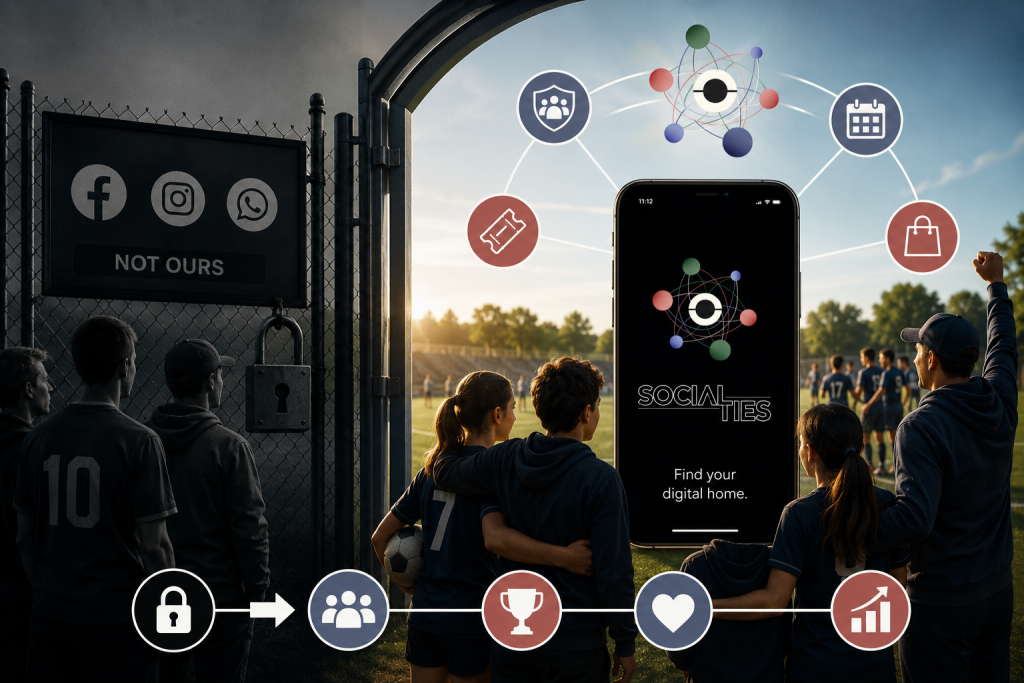
Imagine spending years building a clubhouse on land you don’t own, only to discover the landlord can change the rules overnight. Raise the rent. Decide who gets in the door. Tear the whole thing down. No community would accept that arrangement in the physical world. Yet online, it has quietly become the norm.
Most community organisations now run on digital tools. Clubs coordinate volunteers through messaging apps. Schools reach parents through social platforms. Events, fundraisers, registrations, ticket sales, member engagement: almost all of it happens online. Digital infrastructure has become as essential to community life as the pitch and the parish hall.
But there is a difference between the two. Communities own their physical assets. They decide how the clubhouse is used and who uses it. They invest in facilities that serve local needs. Digital infrastructure is usually the opposite. Communication runs through global networks the community does not control. Member data sits inside third-party systems. Visibility depends on algorithms tuned for advertising revenue, not community wellbeing.
So as community life moves online, one question matters more than any other: who owns the infrastructure that holds people together?
What "community-owned" actually means
Community-owned digital infrastructure is built to serve the community first, not external shareholders. The people in the community come before the metrics.
This does not mean a club has to build its own software. It means the platform it relies on is structurally on its side. In practice, that comes down to three things:
The community gets its own branded home, controlled by them, not a generic page inside someone else’s network. The community keeps its own data and relationships, rather than handing them to a system designed for a different purpose. And the value the community creates flows back to the community. At SocialTies, that last point is concrete: the platform is funded by hyperlocal advertising, and half of that advertising revenue is reinvested directly back into the community.
That is the line between ownership and renting. Not warm words about being community-first, but a model where the community owns its presence, owns its data, and owns a real share of the revenue its engagement generates.
Why ownership matters
When a platform’s main goal is advertising revenue for its shareholders, its decisions follow that goal: engagement, attention, growth, time on screen.
When a platform’s main goal is community strength, the priorities look different. Long-term participation. Trust. Local connection. Support for volunteers. Sustainable engagement instead of constant churn.
Communities that depend entirely on platforms they don’t control are exposed. A policy change, a drop in organic reach, a rise in costs, a shift in user behaviour: any of these can cut a community off from the people it spent years gathering. Communities that build on infrastructure aligned with their own goals get something rarer instead: stability and independence.
The hidden cost of renting your community
Many organisations have become renters online without ever choosing to. They spend years building an audience on a social platform, then find that reaching that same audience gets harder and more expensive every season. They move members onto channels they don’t control. They store years of community relationships inside systems built for something else entirely.
That creates a dependency that is hard to escape, and the rent only ever goes up.
Community-owned digital infrastructure is the alternative: permanence, continuity, and local control, rather than building on borrowed land.
Building stronger communities in a digital age
The question facing modern communities is not whether to use technology. Technology is already woven into how people communicate and take part. The real question is whether that technology strengthens the community or quietly pulls it apart. Strong digital infrastructure should do four things.
Make participation easier. News, fixtures, results, content, and communication in one place, so members aren’t hunting across WhatsApp, Facebook, and email to stay involved.
Strengthen local connections. People connect around the thing they actually belong to, their club, county, or cause, rather than whatever an algorithm decides to show them that day.
Support volunteers. Less admin, fewer scattered channels to manage, and tools that lighten the load on the people holding the community together.
Keep value local. Money raised from local advertising stays local and is reinvested into the community, instead of flowing out to shareholders somewhere else.
The next decade
Over the coming years, communities will be defined not only by their physical spaces but by their digital ones. The organisations that thrive will be those that put durable digital foundations in place that reflect their values, rather than relying on disconnected tools that were never designed with community in mind.
That means building digital spaces where people can connect, take part, support local initiatives, and strengthen the places they care about. At its heart, community-owned digital infrastructure is about independence: making sure the systems a community depends on are adding value to it, not extracting value from it.
Where SocialTies fits in
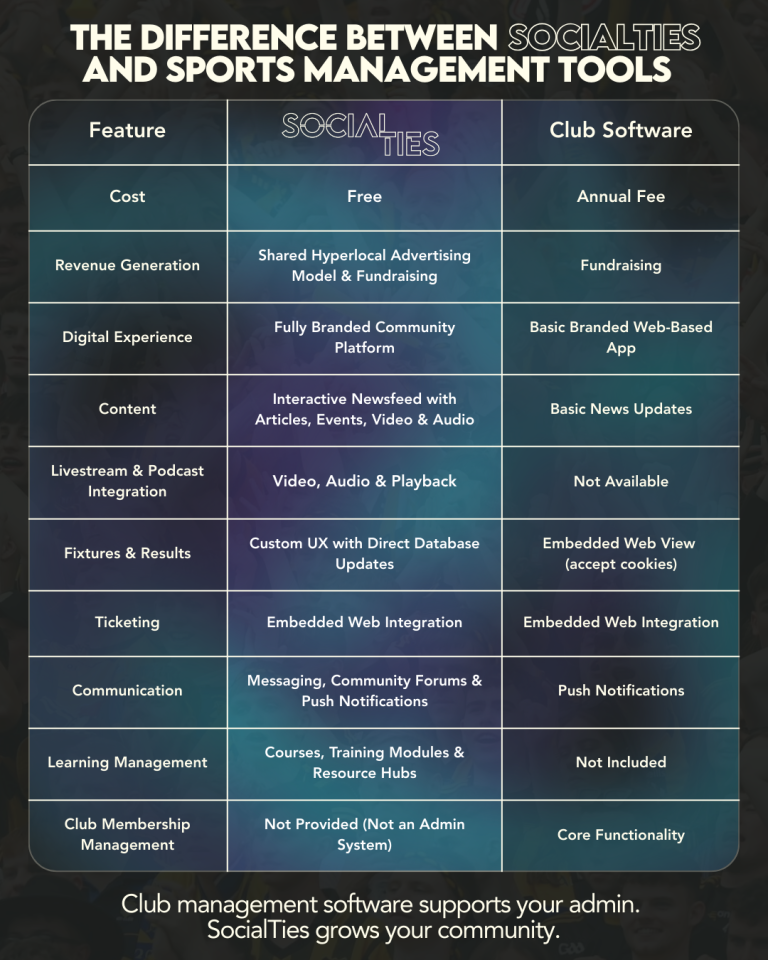
SocialTies is community-owned digital infrastructure. We give communities a fully branded digital home for their members and supporters: news, content, communication, and commerce in one place, funded by hyperlocal advertising, with half the revenue returned to the community.
Across every kind of community we work with, the goal stays the same: helping people feel more connected to the places and organisations they care about, through one home they actually own a stake in.
Technology should not replace community. It should strengthen it. That is the principle behind community-owned digital infrastructure, and the principle behind everything we build.
Get started
Communities are strongest when they have the tools, connections, and support to thrive. If your organisation is looking for a better way to engage members, strengthen participation, and build lasting local connections, get in touch with SocialTies and see what community-owned digital infrastructure looks like in practice.